


The SkyAI Board’s voting decision allows for continued focus on the Solana Treasury Strategy.
Crypto markets tend to simplify complex infrastructure changes into one day of price action. On Sept., The Block reported on this. The separation of the underlying event and how the market interpreted that event will help you better understand what occurred.
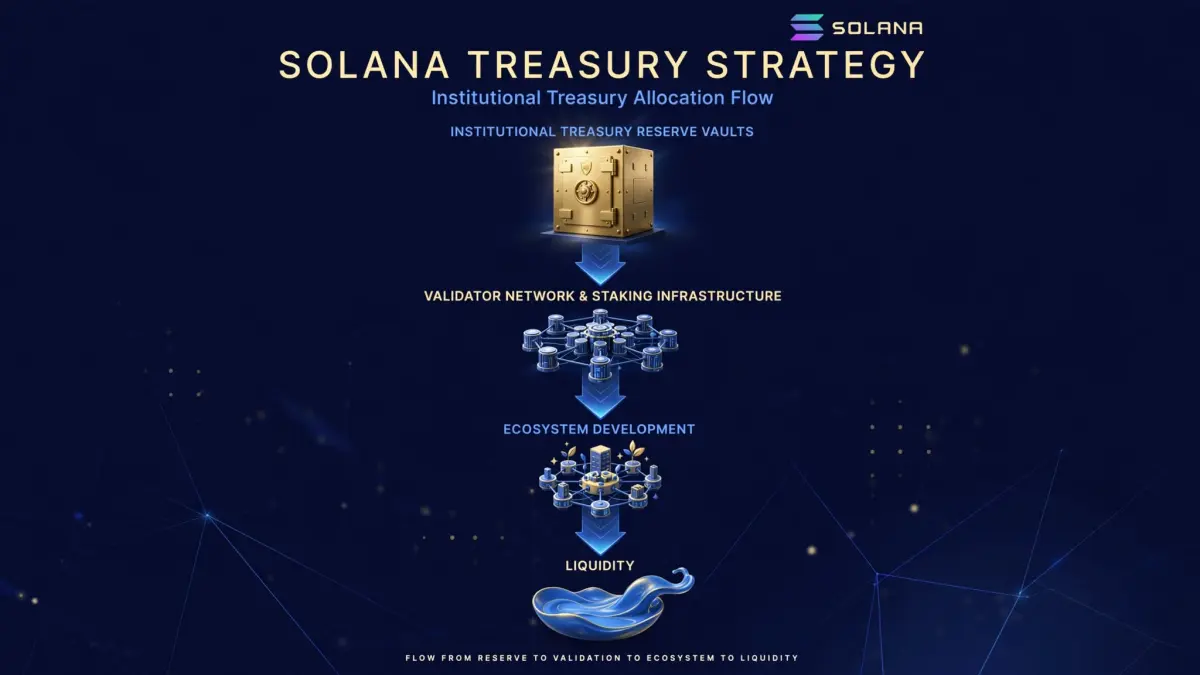
The decision of a corporation to cast their vote will be an indicator for the Solana market.
The Block reported about this event in September. This is a practical, not a marketing event; so that the reader will be able to see exactly what has changed, who is affected and where in the cryptocurrency stack there are risks/opportunities.
Treasury risk does not equal protocol demand
The first big issue with Solana’s treasury strategy is what the underlying mechanics do. It’s important to understand this since the labels used may obscure how the underlying technology or finances work. For example, a wallet permission is different than custody. A tokenized fund is different than a liquid public security. A regulatory FAQ is different than a legally binding regulation. To analyze the issues effectively, one needs to differentiate among these types of things, and then ask how we can tell if the changes have worked in reality.
Shareholders are taking a different approach to funding their businesses.
Another question is scale. One big deal, one announcement of an early adopter, etc., will prove that something can happen but not necessarily that it has longevity. For Solana Treasury Strategy, we should expect to see continued use, deeper liquidity, new participants, clear regulatory framework, and/or quantifiable security enhancements in the next round of data. This type of information is important because crypto prices are typically based on narrative until the technology itself reaches a stage of operation where it can be considered mature.
How long will the results last?
A potential risk also exists. An efficient infrastructure that allows for great speed may also introduce new failure modes. Too much access control in automated systems will allow users to quickly transfer money. Tokenized assets that use out-of-date pricing can lead to incorrect valuations of collateral. If a bridge or back end authorization layer fails, the loss can occur beyond what the user believed was being protected. Therefore, evaluating Solana’s treasury strategies should be viewed as part of a system and not as a separate function.
The evidence needs to show what is coming up next.
Solana’s Treasury Strategy has been carefully designed to have a very limited scope. It uses the first-hand (primary) reporting identified in the Sources section to provide information about the topic. It also clearly separates what was said about a company, regulator, or project from what the author thought about it. When a company, regulator, or project makes a claim, it will be stated by the author as their claim; however, if the author states something as a fact, then it is assumed to be true. It is extremely important for Solana’s Treasury Strategy to take this type of approach, because if there are still many unanswered legal, technical, or market-related issues surrounding the topic, it can easily lead readers to believe that these issues are already resolved.
The real-world application of this is that:
For readers who want to understand how Solana manages their treasury strategy, the best thing you can do is check the evidence once again after the initial reaction of the markets. See if there are operational changes, if users and/or institutional investors continue to buy/sell, and if the risks we have described in this article have been mitigated or simply moved. A truly long-term development will be able to handle that second assessment. If it cannot, then the proper reaction is to update your analysis rather than defend the original headline.
A larger effect on the market
The story also forms part of a larger change in how people use their digital assets. Companies and regulators have been demanding better control of the way that people store their digital assets, keep track of them, and protect themselves against loss. While the transition may still be taking place, the focus of the competition has changed from “is there a tool that does x” to “does the environment that supports this tool work well enough to allow us to rely on it to function consistently at the same level of performance as we expect from our systems today.”
What makes development sustainable?
The reason for not having one headline conclusion in this article is because there may be an impact of the Solana Treasury Strategy even if the token does not move right away; however, a large market reaction does not mean that the thesis will last. Therefore, the best way to determine the validity of the strategy is through “repeatability.” Can the strategy be used again in normal circumstances where there is sufficient liquidity and control so that a user could use the strategy? This type of evidence is what needs to be followed up on. This same discipline should be used when looking at subsequent updates: confirm the next filing, release, transaction, or measured usage prior to considering the update as part of the established market structure.