


How Crypto Market Makers Move Large Token Positions
Understanding market makers helps readers interpret large wallet transfers without assuming that every transfer means an immediate sale. The latest data and reporting point to a crypto market that is becoming more dependent on infrastructure details. The headline move is only the starting point; the more useful question is what the underlying mechanism means for users, liquidity and the companies building around it.
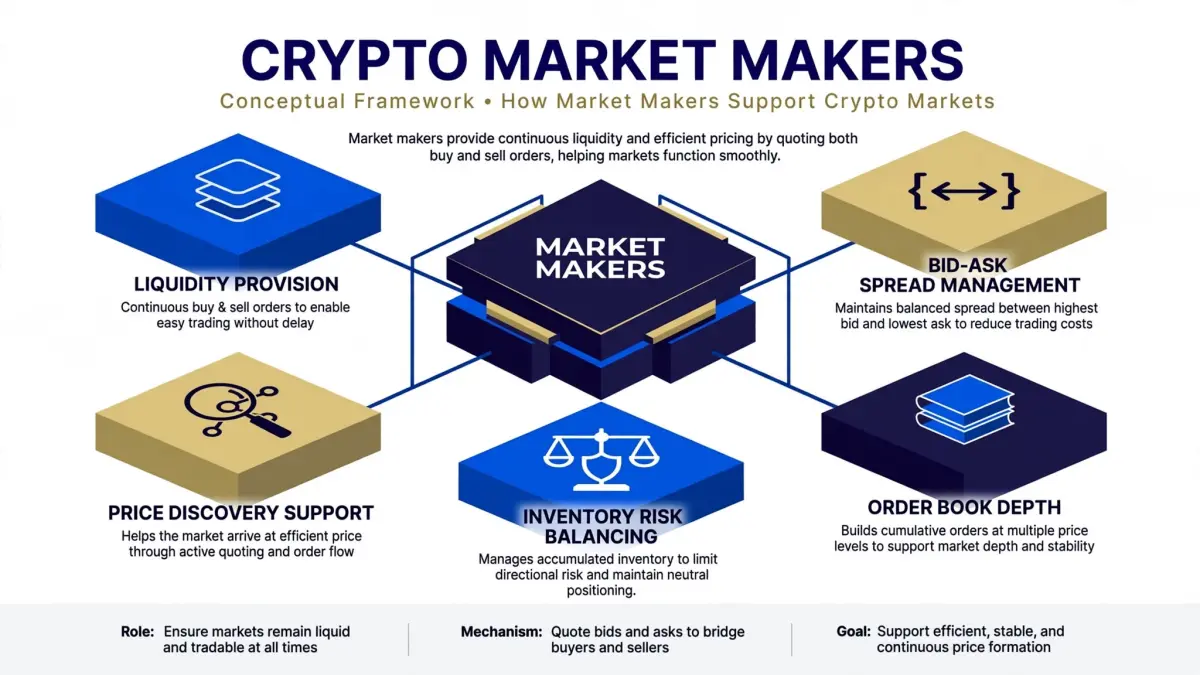
A useful rule for readers is to ask three questions: what happened, what evidence proves it, and what evidence would be needed to establish the next claim. That simple sequence prevents a large share of the common mistakes made when interpreting blockchain data.
The reporting available on 23 September 2026 provides the factual starting point. Where the story involves a technical or financial claim, this article separates what the source documents from what market participants might infer. That distinction is particularly important in crypto, where a wallet transfer, a testnet announcement or a regulatory proposal can be interpreted much more aggressively than the underlying evidence supports.
A useful rule for readers is to ask three questions: what happened, what evidence proves it, and what evidence would be needed to establish the next claim. That simple sequence prevents a large share of the common mistakes made when interpreting blockchain data.
What a market maker actually does
The central fact is narrower than the broader narrative. The available reporting describes a specific event or development, and that is the part readers can treat as established. Claims about future market impact require more caution. In crypto, the same event can improve infrastructure while having little immediate effect on token prices.
A useful rule for readers is to ask three questions: what happened, what evidence proves it, and what evidence would be needed to establish the next claim. That simple sequence prevents a large share of the common mistakes made when interpreting blockchain data.
That distinction matters because crypto markets often react before the underlying facts are fully established.
A useful rule for readers is to ask three questions: what happened, what evidence proves it, and what evidence would be needed to establish the next claim. That simple sequence prevents a large share of the common mistakes made when interpreting blockchain data.
Why large transfers can be ambiguous
Market context helps explain why the development is receiving attention. Bitcoin remains the primary liquidity benchmark, while stablecoins, tokenized assets, decentralized finance and blockchain infrastructure increasingly overlap with traditional finance. That makes category labels less useful than they were several years ago. A technology story can quickly become a payments or regulatory story once institutions begin using it.
A useful rule for readers is to ask three questions: what happened, what evidence proves it, and what evidence would be needed to establish the next claim. That simple sequence prevents a large share of the common mistakes made when interpreting blockchain data.
For readers, the useful approach is to separate the confirmed event from the interpretation that may follow.
A useful rule for readers is to ask three questions: what happened, what evidence proves it, and what evidence would be needed to establish the next claim. That simple sequence prevents a large share of the common mistakes made when interpreting blockchain data.
How to read onchain movements carefully
The most important uncertainty is what has not yet happened. A testnet feature is not a production deployment. A regulatory proposal is not a final rule. A wallet transfer is not proof of a completed sale. A forecast from an institution is not a market guarantee. Keeping those distinctions visible is essential to accurate reporting.
A useful rule for readers is to ask three questions: what happened, what evidence proves it, and what evidence would be needed to establish the next claim. That simple sequence prevents a large share of the common mistakes made when interpreting blockchain data.