


SEC’s Tokenized-Stock Rules Could Turn Public Blockchains Into Market Infrastructure
SEC’s Tokenized-Stock Rules Could Turn Public Blockchains Into Market Infrastructure is about the technical conditions embedded in the SEC’s new tokenized-stock exemption. The immediate facts matter, but so does the context around them. The SEC says TSV smart contracts must be auditable, public and deployed on a public, permissionless distributed ledger. This article separates what has been confirmed from what remains interpretation, then looks at the practical questions for readers, builders and market participants.
The technical rules are as important as the legal relief
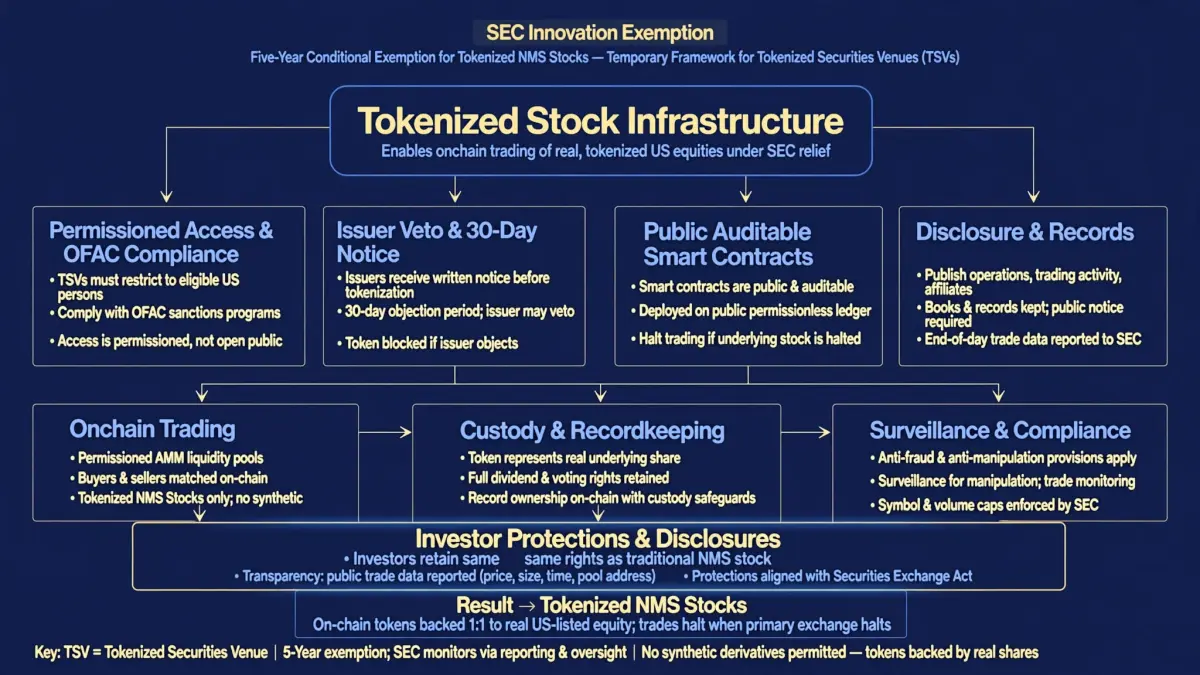
The SEC says TSV smart contracts must be auditable, public and deployed on a public, permissionless distributed ledger. The development should be read against the broader structure of the digital-asset market. Tokenized stocks must coordinate trading stoppages with the underlying stock’s primary listing exchange. That does not prove a direct causal relationship, but it explains why the story is receiving attention now. Markets price several variables at once, and a single headline is rarely the whole explanation.
Permissioned trading on public ledgers
Tokenized stocks must coordinate trading stoppages with the underlying stock’s primary listing exchange. There is an important distinction between an announced capability and a mature market outcome. The framework creates a bridge between permissioned market access and public blockchain infrastructure rather than making stock trading fully permissionless. The next test is execution: whether the system works under real demand, whether participants continue using it after launch attention fades, and whether surrounding infrastructure develops enough depth to support repeat activity.
Smart contracts become regulated infrastructure
The exemption also requires public notice about TSV operations and trading activity. For readers, the useful question is what can be verified today. Tokenized stocks must coordinate trading stoppages with the underlying stock’s primary listing exchange. Everything beyond that belongs in the analysis column rather than the confirmed-fact column. That distinction is especially important in crypto, where announcements can move prices before the underlying product, rule or network change has been tested at scale.
Why interoperability and settlement will matter
The framework creates a bridge between permissioned market access and public blockchain infrastructure rather than making stock trading fully permissionless. The development should be read against the broader structure of the digital-asset market. The SEC says TSV smart contracts must be auditable, public and deployed on a public, permissionless distributed ledger. That does not prove a direct causal relationship, but it explains why the story is receiving attention now. Markets price several variables at once, and a single headline is rarely the whole explanation.
What to watch next
The next phase will be determined by evidence rather than headlines. For this story, the most useful signals are changes in real usage, liquidity, regulatory implementation, developer activity, market participation and the behavior of the underlying assets. The SEC says TSV smart contracts must be auditable, public and deployed on a public, permissionless distributed ledger. Readers should also check the primary documents linked in the sources section when a claim has legal, technical or financial significance.
The takeaway
The central point is straightforward: the technical conditions embedded in the SEC’s new tokenized-stock exemption. The confirmed record provides the foundation, while market interpretation should remain conditional. Tokenized stocks must coordinate trading stoppages with the underlying stock’s primary listing exchange. As new data arrives, the story may evolve, and that is normal in a fast-moving market. UnmaskCoins treats the article as a dated research snapshot rather than a prediction of certainty.