


Why Privacy Coins Are Regaining Attention While Crypto Regulation Tightens
Monero and Zcash have recently attracted stronger market attention than many other large crypto assets. The larger market question is what this says about crypto’s structure rather than what one trading session says about price. Privacy Coin Market has become important because it connects capital flows, liquidity, risk management and the expanding relationship between digital assets and traditional finance.
Privacy Coin Market Is Becoming a Market-Structure Issue
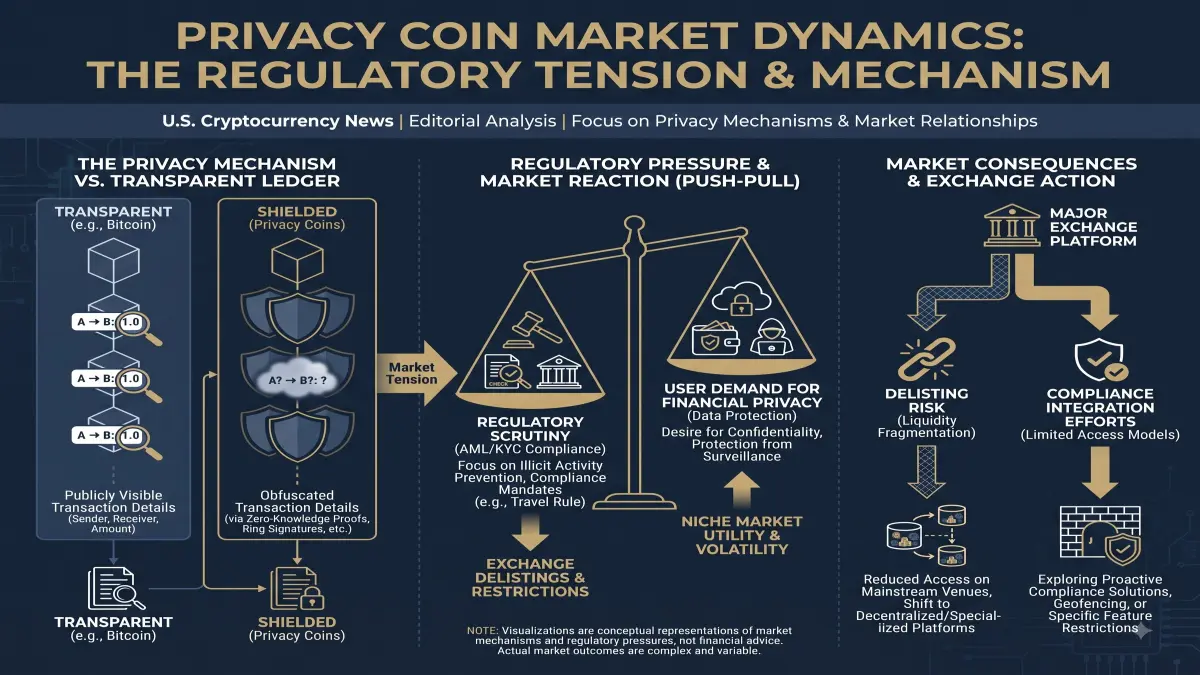
The appeal is tied to transaction privacy, fungibility and a distinct use case from transparent smart-contract networks. That creates a feedback loop. More liquidity can attract more trading, more trading can deepen infrastructure, and deeper infrastructure can bring in participants who previously stayed away. But the same loop can work in reverse when leverage disappears or risk appetite falls.
At the same time, privacy features can create compliance challenges for exchanges, custodians and regulated financial institutions. The number is useful, but context matters. Market data can describe what happened without explaining why it happened or whether it can persist. A temporary surge in volume, for example, may come from incentives, liquidations or a short-lived narrative. Sustainable growth requires recurring users and capital that remains when conditions become less favorable.
This is where market structure becomes more important than a simple price chart. A mature market has multiple sources of liquidity, a diverse participant base and mechanisms for transferring risk. It also has clear rules around custody, settlement and disclosure. Crypto is still building many of these layers, which is why individual protocol launches can have market-wide consequences.
The Signal Behind the Numbers
The result is a market where technological utility and regulatory accessibility can pull in opposite directions. That is the signal worth monitoring. If the trend persists across several weeks and different market conditions, it becomes more credible as structural evidence. If activity disappears as incentives change, the earlier surge should be treated as a temporary market event rather than a new equilibrium.
Institutional participation adds another layer. Professional investors often care less about headline returns than about liquidity, custody, settlement and compliance. A market can therefore become more institutionally useful even while retail speculation becomes less dominant. Conversely, a market that relies heavily on leverage may look liquid until volatility forces positions to close.
What Could Break the Trend
The long-term question is whether privacy can become an accepted financial feature rather than a reason for exclusion from regulated markets. Macro conditions are another constraint. Higher yields, tighter financial conditions or geopolitical shocks can reduce risk appetite even when crypto-specific fundamentals are unchanged. Regulatory decisions can have a similar effect by changing which entities are willing to participate.
The strongest market analysis therefore avoids one-variable explanations. Crypto prices can move because of flows, leverage, macroeconomics, technology, regulation and narrative. The useful task is to identify which variable is dominant now and which variables could replace it. That keeps the analysis adaptable instead of forcing every move into a single story.
The Data to Watch Next
Readers should track the quality of liquidity, not only its size. Useful indicators include stablecoin supply, exchange balances, derivatives open interest, funding, spot volumes, ETF flows where relevant and onchain activity. No single metric is decisive. The combination is more informative because it shows whether demand is cash-driven, leverage-driven or incentive-driven.
The current picture supports a cautious interpretation: crypto’s financial plumbing is becoming deeper, but it is also becoming more connected to the same liquidity and risk cycles that shape traditional markets. That is progress in one sense, but it means crypto is not insulated from broader financial conditions.
Timing also matters. Crypto markets can absorb a positive development quickly when liquidity is strong, but the same development may receive little attention during a broad risk-off move. That does not make the underlying technology less important. It means market reaction and fundamental value can move on different clocks. Readers should separate the short-term trading response from the longer-term question of whether the change improves utility, reduces friction or strengthens the ecosystem.
The broader lesson is that crypto adoption is increasingly being decided at the infrastructure layer. Faster settlement, better controls, interoperable wallets, clearer rules and deeper liquidity can matter more over time than a single token narrative. That is why developments like this deserve attention even when they do not immediately produce a dramatic price move. The durable impact will be measured by whether other companies, developers and users begin building around the change.