

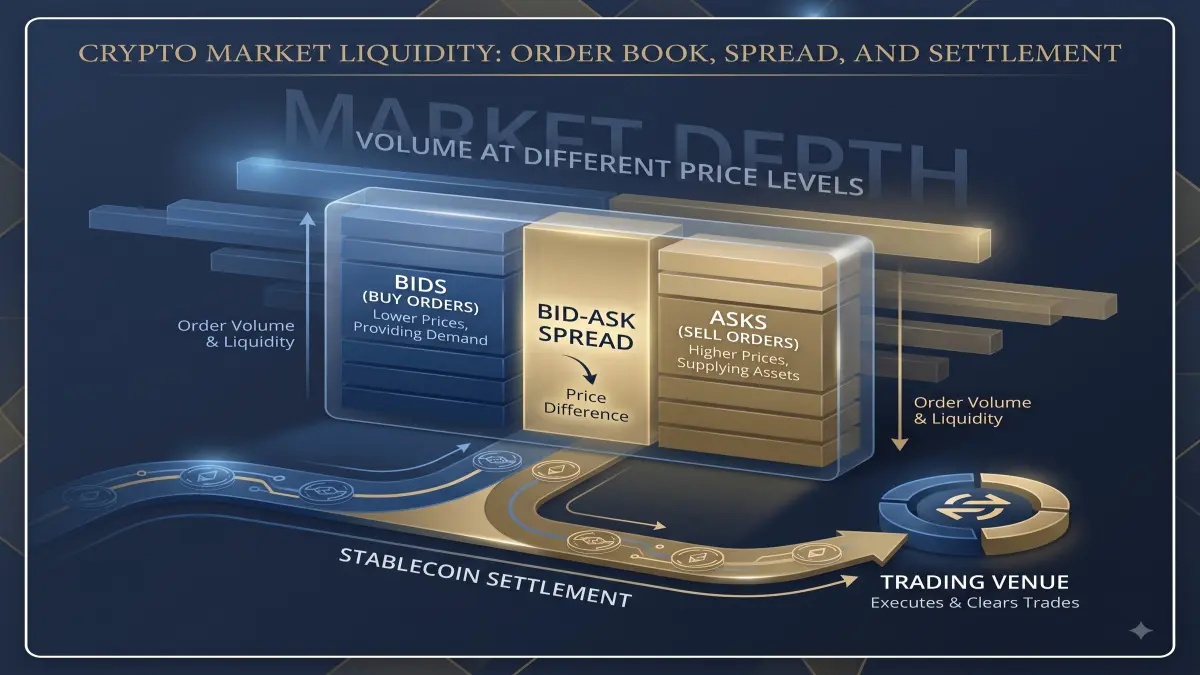
What Crypto Market Liquidity Actually Means and Why It Matters
Liquidity is one of the most important concepts in digital-asset markets because it determines how easily buyers and sellers can transact without moving prices sharply. Understanding depth, spreads, volume and stablecoin availability makes market behavior easier to interpret. The discussion below separates confirmed developments, market data and analytical interpretation.
crypto market liquidity and the current picture
Liquidity is one of the most important concepts in digital-asset markets because it determines how easily buyers and sellers can transact without moving prices sharply. Understanding depth, spreads, volume and stablecoin availability makes market behavior easier to interpret. The simplest way to understand the subject is to start with the mechanism rather than the jargon. Liquidity describes the ability to buy or sell an asset with limited price impact. That definition matters because many crypto headlines describe outcomes without explaining the underlying system.
Once the basic mechanism is clear, readers can distinguish genuine market signals from short-term noise and marketing language.
Spreads reveal the cost of entering and exiting
The next layer is the data. Order-book depth, bid-ask spreads and trading volume are common indicators. These indicators do not work independently. A market can show high reported volume while still having poor depth, or a wallet can use strong key custody while remaining vulnerable to phishing. The quality of a security or market assessment therefore depends on looking at the whole chain of controls rather than one attractive metric.
One common mistake is treating a visible feature as proof of safety or strength. Stablecoins often function as transaction and settlement liquidity within crypto markets. In practice, crypto systems are collections of software, people, permissions and external services. A failure in any one of those layers can create consequences that the headline metric does not show. This is why experienced analysts look for dependencies and failure modes, not just headline performance.
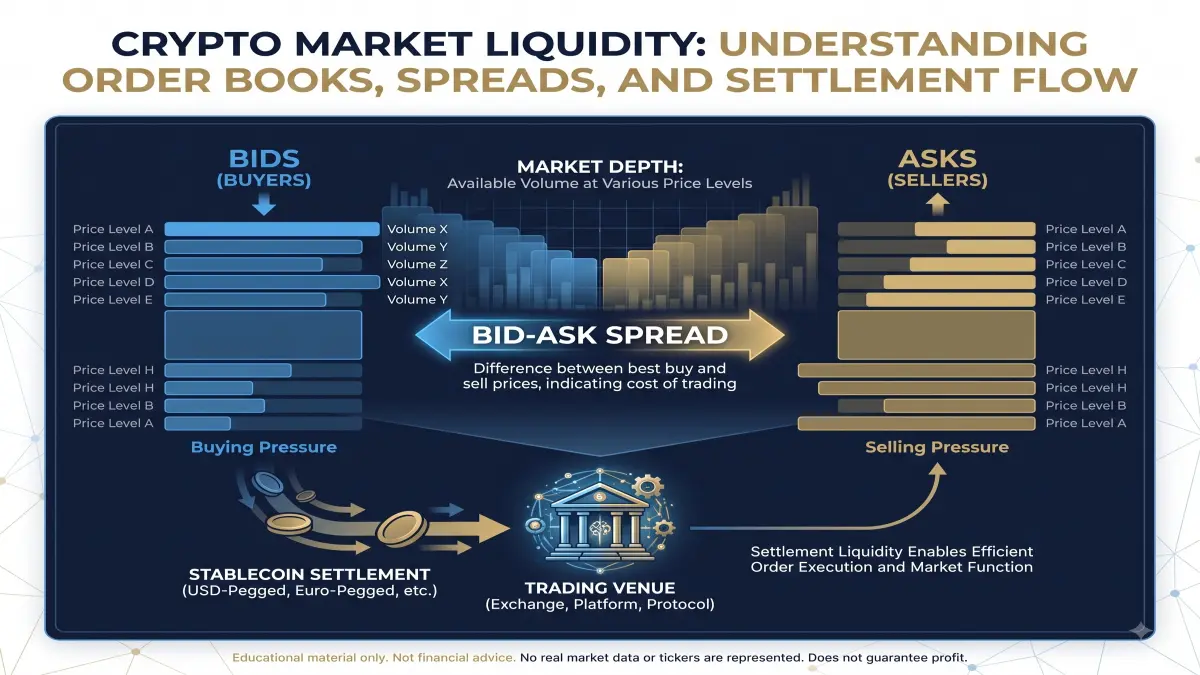
Stablecoins can act as the market’s settlement fuel
Another useful distinction is between liquidity and price, or between custody and authorization. The two concepts interact, but they are not interchangeable. Low liquidity can amplify volatility, slippage and liquidation cascades. A liquid market can still be dangerous if leverage is excessive. A secure hardware wallet can still be exposed if a user approves a malicious transaction. Understanding these boundaries makes technical discussions much easier to follow.
Readers should also pay attention to incentives. Protocols, exchanges and wallet providers make design choices because they are balancing security, convenience, capital efficiency and user growth. Those trade-offs are not automatically bad, but they should be visible. A system that is exceptionally convenient may expose more attack surface, while a system with strict controls may impose more friction.
Thin liquidity makes volatility more dangerous
The practical takeaway is to treat crypto infrastructure as a system rather than a single product. For markets, that means watching depth, spreads, volume, collateral and stablecoin availability together. For wallets, it means protecting keys while also verifying software, domains, permissions and transaction details. The goal is not to eliminate every risk, which is impossible, but to avoid relying on one defensive layer.
Current events make the lesson easier to see. Recent reporting on security incidents and market stress shows that failures often emerge at the boundaries between systems. Those boundaries include bridges, third-party vendors, browser interfaces, exchange APIs and automated agents. The more connected crypto becomes to traditional finance and AI-driven services, the more important boundary management becomes.
How traders should read liquidity data
A useful mental model is therefore simple: identify the asset or system, identify the mechanism that creates value, identify the mechanism that creates risk, and then identify what evidence would change your view. That approach is more durable than memorizing a list of buzzwords. It also helps readers evaluate new crypto products without assuming that a familiar label means the underlying risk is familiar.
The broader lesson is that crypto literacy is increasingly about systems thinking. Prices, wallets, liquidity, smart contracts and regulations interact. Readers who understand those relationships can interpret market moves and product announcements with greater discipline. The objective is not to predict every outcome, but to understand what has to be true for an outcome to occur and what could cause the thesis to fail.
How traders should read liquidity data
The practical implication is to watch the evidence that can be measured rather than the narrative that can be repeated. Market participants can disagree about direction while still agreeing about the underlying facts.
That distinction becomes especially important in crypto because information travels quickly and liquidity can change before a longer-term thesis has time to develop.