

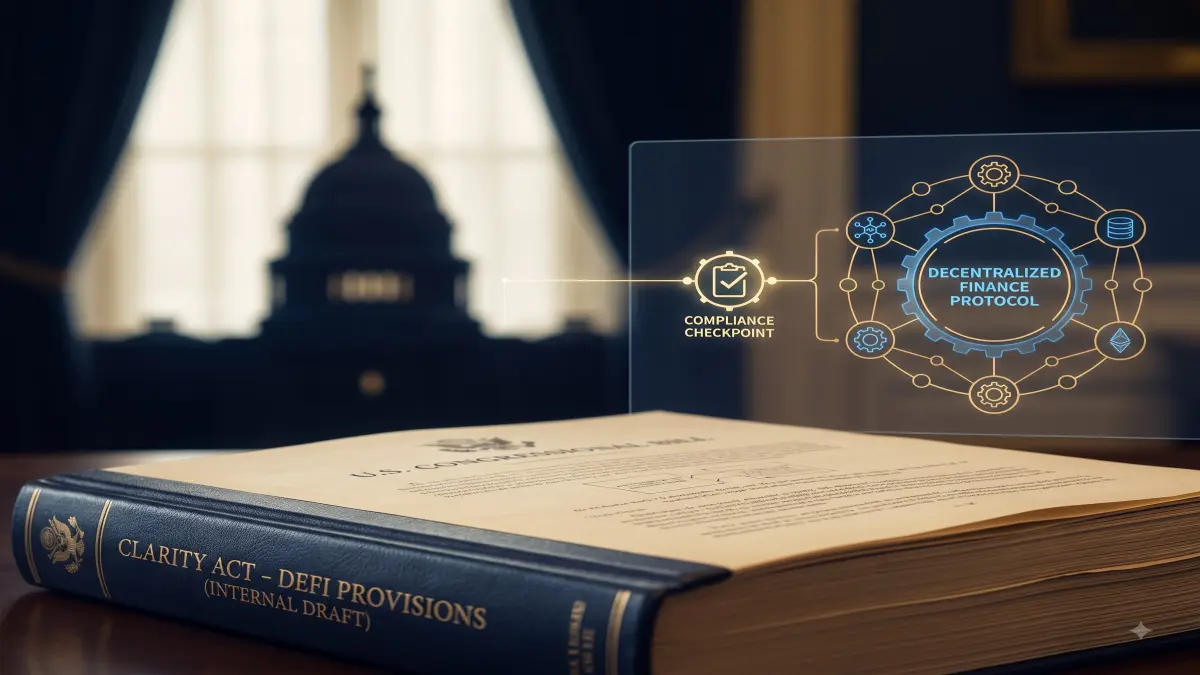
Revised Clarity Act Text Puts DeFi Registration Back in Focus
Senate Republicans circulated a revised Digital Asset Market Clarity Act ahead of a key vote, with new language addressing when non-decentralized DeFi protocols would face CFTC registration and Bank Secrecy Act obligations. The discussion below separates confirmed developments, market data and analytical interpretation.
Clarity Act DeFi provisions and the current picture
Senate Republicans circulated a revised Digital Asset Market Clarity Act ahead of a key vote, with new language addressing when non-decentralized DeFi protocols would face CFTC registration and Bank Secrecy Act obligations. The immediate facts are more useful than the headline alone. The revised bill was described as a 630-page text. That development matters because it changes the information set available to traders, builders, institutions or regulators. It does not automatically determine what happens next. The strongest reading is to separate the confirmed event from the market interpretation that follows.
The second point is context. The update includes provisions concerning non-decentralized DeFi protocols. The market is not operating in isolation: liquidity, macroeconomic conditions, regulation and the behavior of large counterparties can amplify or mute the impact of a single development. That is particularly important in crypto, where a large move can quickly become a story about sentiment even when the underlying change is narrow.
The registration question is central to the bill
A third issue is what the event actually changes. The proposal also addresses prediction markets and certain credit-union digital-asset activities. In some cases the effect is immediate, such as a product launch, security response or regulatory proposal. In others, the significance lies in what the development makes possible later. The distinction matters because investors often price a future narrative before the operational evidence exists.
The fourth question is who absorbs the risk. The legislation still faces a difficult 60-vote Senate threshold and unresolved bipartisan concerns. A protocol may gain efficiency while shifting complexity to liquidity providers. A regulator may create clarity while increasing compliance costs. An institutional partnership may open a new market while raising the standard for security and reporting. The distribution of costs and benefits often tells a clearer story than the announcement itself.

Prediction markets complicate the regulatory map
That is where the broader market becomes relevant. Bitcoin remains the largest pool of crypto capital, while Ethereum and large altcoins capture substantial liquidity of their own. Stablecoins connect much of that activity to dollar-denominated settlement. Changes in rates, oil prices or institutional flows can therefore affect the same projects that appear to have asset-specific catalysts.
The current evidence also argues against overstatement. The revised bill was described as a 630-page text. does not prove a long-term trend by itself. Nor does one weak session invalidate a structural thesis. Good crypto analysis treats new information as an update to a probability distribution rather than a verdict. That approach is especially important when a story is moving faster than the underlying data.
The vote is important, but passage is not assured
For market participants, the useful watchpoints are concrete. Track whether users, liquidity or capital actually follow the announcement. Watch for secondary effects in volumes, spreads, funding, custody or developer activity. Where a proposal is regulatory, watch the next procedural step rather than assuming passage. Where it is technical, watch deployment and adoption rather than relying only on the design claim.
The strongest conclusion is therefore narrower than the loudest headline. The development changes the landscape in a specific way, but its ultimate significance depends on execution, adoption and the response of competing systems. That uncertainty is not a weakness in the analysis; it is part of the information that readers need.
The vote is important, but passage is not assured
Taken together, the evidence supports a measured view. Crypto remains a market where technology, capital and policy can move at different speeds. The best way to follow this story is to keep the confirmed facts separate from the scenarios and to revisit the thesis when new evidence arrives. That is more useful than treating a single announcement as a guaranteed turning point.
The practical implication is to watch the evidence that can be measured rather than the narrative that can be repeated. Market participants can disagree about direction while still agreeing about the underlying facts.
That distinction becomes especially important in crypto because information travels quickly and liquidity can change before a longer-term thesis has time to develop.
Readers should also verify current conditions because prices, flows, regulations and product availability can change after publication.
The practical implication is to watch the evidence that can be measured rather than the narrative that can be repeated. Market participants can disagree about direction while still agreeing about the underlying facts.